
HCF and LCM are two must-know concepts in arithmetic and competitive exams. HCF (Highest Common Factor) is the greatest number that divides two or more numbers exactly, while LCM (Lowest Common Multiple) is the smallest number that is a common multiple of two or more numbers. These topics look basic, but they appear repeatedly in aptitude because they build the foundation for many faster calculations. If your basics are clear, you can solve questions quickly without getting confused between “divide” and “together” type problems. In these Guide –
What is HCF and LCM with Example
HCF and LCM are two basic but very important concepts in arithmetic. They help you solve many number-based problems faster, especially in competitive exams. The main difference is simple: HCF is about division, while LCM is about multiples.
| Feature | HCF (Highest Common Factor) | LCM (Least Common Multiple) |
| Full Form | Highest Common Factor (also called GCD) | Least Common Multiple |
| Core Concept | Finding the largest divisor common to all numbers. | Finding the smallest number that is a multiple of all numbers. |
| Logic | “What is the biggest number I can divide these by?” | “What is the first number that appears in all their times tables?” |
| Value Relationship | The HCF is always smaller than or equal to the smallest number in the set. | The LCM is always greater than or equal to the largest number in the set. |
| Example (12 and 18) | Factors of 12: 1, 2, 3, 4, 6, 12 Factors of 18: 1, 2, 3, 6, 9, 18 HCF = 6 | Multiples of 12: 12, 24, 36, 48 Multiples of 18: 18, 36, 54, 72 LCM = 36 |
| Primary Use Case | Used for simplifying fractions or distributing items into equal groups. | Used for finding common denominators or determining when two periodic events will sync up. |
What is HCF (Highest Common Factor)
The Highest Common Factor (HCF), also known as the Greatest Common Divisor (GCD), is the greatest number that is a factor of two or more integers.
Example:
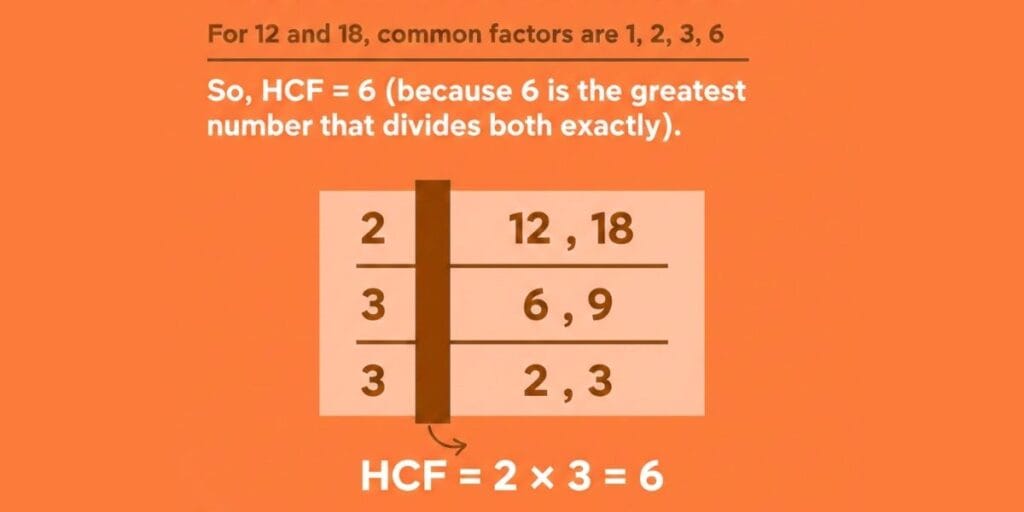
For 12 and 18, common factors are 1, 2, 3, 6.
So, HCF = 6 (because 6 is the greatest number that divides both exactly.
2 | 12 , 18
3 | 6 , 9
| 2 , 3
= 2
HCF is used when you want to divide things equally, make maximum equal groups, or find the largest size possible without leftovers (like distributing items, cutting pieces equally, etc.)
What is LCM (Least Common Multiple)
The Least Common Multiple (LCM) of a set of integers is the smallest positive integer that is divisible by each of the numbers in the set without leaving a remainder.
Example:
Multiples of 4: 4, 8, 12, 16, 20…
Multiples of 6: 6, 12, 18, 24…
So, LCM = 12 (smallest common multiple).
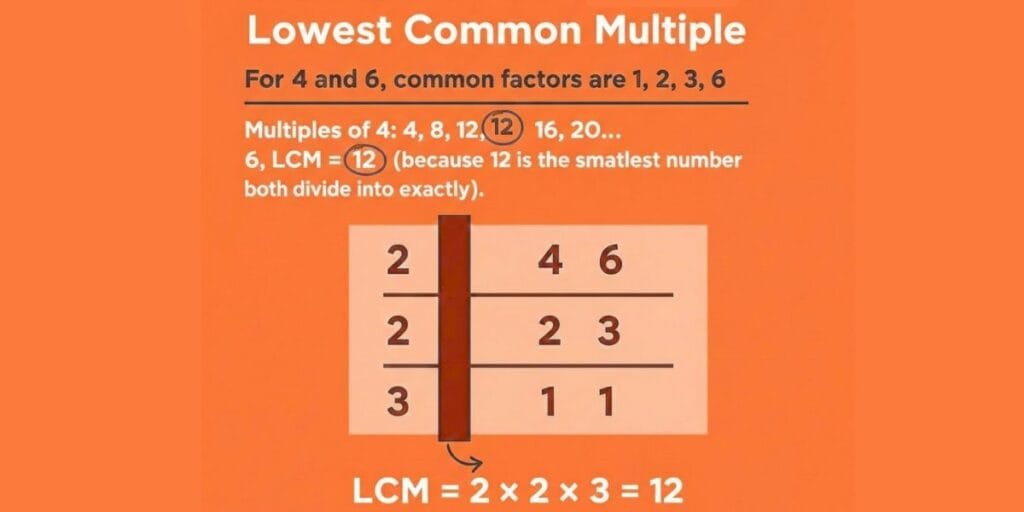
Prime | 4 6
2 | 2 3
2 | 1 3
3 | 1 1
LCM is used when events repeat together, like bells ringing, lights blinking, schedules, cycles, and time interval problems.
Fundamental Properties of HCF and LCM for Two or More Numbers
For two numbers
For two positive integers (a) and (b), the most popular and time-saving relation is the product formula:
a × b = HCF(a, b) × LCM(a, b)
So you can write:
- LCM(a, b) = (a × b) / HCF(a, b)
- HCF(a, b) = (a × b) / LCM(a, b)
This formula works only when you are dealing with two numbers (and usually taken as positive integers). Also, it must be the HCF and LCM of the same two numbers. Many students wrongly try to apply it to three or more numbers directly.
Quick example:
If (a = 12) and (b = 18), HCF = 6.
Then LCM = ((12 × 18) / 6 = 36).
Check: (12 × 18 = 216) and (6 × 36 = 216)
For more than two numbers
For three or more numbers, there is no single direct product formula like above. Instead, we use the pairwise idea step-by-step:
- HCF of (a, b, c) = HCF(HCF(a, b), c)
- LCM of (a, b, c) = LCM(LCM(a, b), c)
First find HCF/LCM of the first two numbers, then combine that result with the third number, and continue the same way if there are more numbers. This method is simple, accurate, and commonly used in competitive exams.
Quick Example :
LCM(4, 6, 8)
Step 1: LCM(4, 6) = 12
Step 2: LCM(12, 8) = 24
So, LCM(4, 6, 8) = 24
Different Methods of HCF And LCM
To find HCF and LCM, think of them as two practical ideas: HCF = biggest number that divides both, and LCM = smallest number that comes in both tables.
How to find HCF(Highest Common Multiple)
There are two methods of finding the highest common factor, Prime factorisation Method and Division Method. the explaination and the examples are shown below:-
Method 1: Prime factorisation
- Break each number into prime factors.
Example: 12 = 2×2×3, and 18 = 2×3×3 - Take only common primes with minimum power → (2×3)
So HCF = 6
Method 2: Division (Euclid)
Example: HCF of 48 and 18
48 ÷ 18 = remainder 12
18 ÷ 12 = remainder 6
12 ÷ 6 = remainder 0
So HCF = 6 (last non-zero remainder)
How to find LCM
There are two methods of finding the Least Common Multiple, Prime factorisation Method and Using Formulas, the explaination and the examples are shown below:-
Method 1: Prime factorisation
Take primes with maximum power.
12 = 2²×3, 18 = 2×3²
LCM = 2² × 3² = 36
Method 2: Using formula (fast in exams)
If you know HCF:
LCM × HCF = Product of numbers
So LCM = (a×b)/HCF
Example: 12 and 18
LCM = (12×18)/6 = 36
When to Use HCF vs LCM
HCF and LCM are used when you need to decide between dividing and matching.
Use HCF for the largest exact division into equal groups, and use LCM for the first common point when repeated cycles meet. Let see it in Detail
Use HCF when you need maximum equal division
HCF tells you the largest number or size that can divide all given quantities exactly with no remainder. It is used when you are making the maximum number of equal groups, cutting items into the largest equal pieces, or distributing things equally without anything left.
Example 1: Gift packs
You have 12 chocolates and 18 candies and want identical packs with nothing left.
HCF(12, 18) = 6
So you can make 6 packs. Each pack will have 12/6 = 2 chocolates and 18/6 = 3 candies.
Example 2: Cutting ropes
Rope lengths are 24 m and 36 m. You want equal pieces of maximum length.
HCF(24, 36) = 12
So each piece should be 12 m.
Use LCM when you need the minimum common meeting point
LCM tells you the smallest time or number when two (or more) events happen together again. It is mostly used in time, schedule, and cycle problems.
Example 1: Bus timing
One bus comes every 12 minutes and another every 18 minutes.
LCM(12, 18) = 36
So they come together after 36 minutes.
Example 2: Machines
One machine produces every 6 seconds and another every 9 seconds.
LCM(6, 9) = 18
So both produce together after 18 seconds.
Quick keyword trick for exams
Maximum, greatest, divide equally, distribute, cut into equal pieces → HCF
Together, again, after how many minutes/days, schedule, cycle → LCM
HCF and LCM Shortcut Tricks
HCF and LCM shortcut tricks are used to solve questions faster without lengthy calculations. These tricks mainly rely on quick factorisation, identifying common factors/multiples, and using the HCF–LCM relationship wherever possible. They are especially helpful in exams because they save time and reduce calculation errors.
HCF Shortcut Tricks
- Use HCF when you see equal division, largest equal groups, or cutting into biggest equal pieces.
Example: 30 pens and 45 pencils into equal packets without leftover. HCF(30,45)=15, so you can make 15 packets. - Fast method (Euclid division): keep dividing and take the last non-zero remainder as HCF.
Example: HCF(48,18)
48 ÷ 18 = remainder 12
18 ÷ 12 = remainder 6
12 ÷ 6 = remainder 0
So HCF = 6. - If one number divides the other, the smaller number is the HCF.
Example: HCF(12,36)=12.
LCM Shortcut Tricks
- Use LCM for together/again/schedule/cycle problems.
Example: Bus A every 8 min and Bus B every 12 min meet again after LCM(8,12)=24 min. - Multiplication trick (very useful):
LCM × HCF = a × b
So LCM = (a×b)/HCF
Example: 12 and 18, HCF=6
LCM = (12×18)/6 = 36. - If numbers are co-prime (HCF = 1), then LCM = product.
Example: 7 and 9 → HCF=1 → LCM=63.
These tricks save time because you first identify the situation (divide equally or match together) and then pick the fastest method.
Find HCF and LCM of 26 and 91 (Prime Factorisation Method)
Step 1: Prime factorisation
26 = 2 × 13
91 = 7 × 13
Step 2: Find HCF
Common prime factor = 13
So, HCF(26, 91) = 13
Step 3: Find LCM
Take all prime factors (common factor taken once): 2, 7, 13
LCM = 2 × 7 × 13 = 182
Quick check using formula
LCM × HCF = 26 × 91
182 × 13 = 2366
26 × 91 = 2366
So it matches.
Final Answer
HCF = 13
LCM = 182
LCM & HCF All Formulas
Finding the Least Common Multiple (LCM) and Highest Common Factor (HCF) is all about understanding the relationship between numbers and their prime building blocks.
Here is a comprehensive breakdown of the formulas and properties you’ll need.
1. The Fundamental Relationship
The most important formula links two numbers ($a$ and $b$) directly to their LCM and HCF.
$$\text{Product of two numbers} = \text{HCF} \times \text{LCM}$$
$$a \times b = \text{HCF}(a, b) \times \text{LCM}(a, b)$$
Note: This specific formula only works for two numbers. It does not consistently apply to sets of three or more numbers.
2. LCM and HCF of Fractions
When you are dealing with fractions, you don’t just find the LCM/HCF of everything. You follow these specific patterns:
- LCM of Fractions = $\frac{\text{LCM of Numerators}}{\text{HCF of Denominators}}$
- HCF of Fractions = $\frac{\text{HCF of Numerators}}{\text{LCM of Denominators}}$
3. Important Properties & Rules
Understanding these shortcuts can save you a lot of calculation time:
| Condition | Rule |
| Co-prime Numbers | If two numbers have no common factors (e.g., 8 and 9), their HCF is 1 and their LCM is their product ($a \times b$). |
| One number is a factor of the other | If $a$ is a factor of $b$, then HCF is $a$ and LCM is $b$. (Example: For 5 and 20, HCF is 5, LCM is 20). |
| HCF and LCM Relationship | The HCF of a group of numbers is always a factor of their LCM. |
4. Methods of Calculation
Prime Factorization Method
- Express each number as a product of prime powers.
- HCF: Take the lowest power of all common prime factors.
- LCM: Take the highest power of every prime factor involved.
Division Method (Long Division)
- For HCF: Divide the larger number by the smaller one. Use the remainder as the new divisor and the previous divisor as the new dividend. Repeat until the remainder is zero. The last divisor is the HCF.
- For LCM: Place numbers in a row and divide by the smallest prime number that goes into at least one of them. Bring down numbers that aren’t divisible. Multiply all divisors at the end.
Practice questions for HCF and LCM
Practicing HCF and LCM questions helps you build speed and accuracy in finding common factors and multiples. These questions also improve your understanding of methods like prime factorisation, division method, and the HCF–LCM relationship. Here are some questions for practice
Practice Questions of Highest Common Factor
Q1. HCF of 36 and 84 (Prime Factorization)
- Step 1: Find prime factors.
- $36 = 2 \times 2 \times 3 \times 3 = 2^2 \times 3^2$
- $84 = 2 \times 2 \times 3 \times 7 = 2^2 \times 3 \times 7$
- Step 2: Identify common factors with the lowest powers.
- Common factors are $2^2$ and $3^1$.
- Result: $HCF = 4 \times 3 = 12$.
Q2. HCF of 45, 60, and 75
Step 1: Find the Prime Factors
Break each number down into its prime components:
- 45: $3 \times 3 \times 5 = 3^2 \times 5$
- 60: $2 \times 2 \times 3 \times 5 = 2^2 \times 3 \times 5$
- 75: $3 \times 5 \times 5 = 3 \times 5^2$
Step 2: Identify Common Prime Factors
Look for the prime numbers that appear in all three lists. Then, pick the lowest power (the smallest number of times they appear) for each.
- Is 2 a common factor? No, it only appears in 60.
- Is 3 a common factor? Yes. The powers are $3^2, 3^1,$ and $3^1$. The lowest is $3^1$.
- Is 5 a common factor? Yes. The powers are $5^1, 5^1,$ and $5^2$. The lowest is $5^1$.
Step 3: Multiply the Common Factors
Multiply these lowest common powers together:
$$HCF = 3 \times 5$$
$$HCF = 15$$
Q3 : Two ropes are 96 m and 144 m long. They are cut into equal pieces of maximum length. Find the length of each piece.
- Logic: Since we are “cutting” into “maximum” equal pieces, we find the HCF.
- Calculation:
- $96 = 2^5 \times 3$
- $144 = 2^4 \times 3^2$
- $HCF = 2^4 \times 3 = 16 \times 3 = 48$.
- Answer: Each piece will be 48 meters long.
Q4: 64 chocolates and 80 biscuits are to be packed in identical packets with no item left. Find the maximum number of packets.
- Logic: We need to distribute two different items into the largest number of identical groups.
- Calculation:
- $64 = 2^6$
- $80 = 2^4 \times 5$
- $HCF = 2^4 = 16$.
- Answer: The maximum number of packets is 16. (Each packet contains 4 chocolates and 5 biscuits).
5. HCF of 270 and 192 (Euclid’s Division Method)
- Logic: We divide the larger number by the smaller one and continue with the remainder until it becomes zero.
- Calculation:
- $270 = (192 \times 1) + 78$
- $192 = (78 \times 2) + 36$
- $78 = (36 \times 2) + 6$
- $36 = (6 \times 6) + 0$
- Result: The last divisor is 6, so the $HCF = 6$.
Practice Questions LCM
Certainly! Here are some practice questions on Least Common Multiple (LCM). I have included a variety of problems, ranging from basic calculations to real-world applications, along with detailed explanations for each.
Practice Questionsof Least Common Multiple (LCM)
Q1. Find the LCM of 12 and 18 using the Listing Multiples method.
- Question: Find the smallest number that is a multiple of both 12 and 18.
- Explanation: * List multiples of 12: 12, 24, 36, 48, 60…
- List multiples of 18: 18, 36, 54, 72…
- The first number that appears in both lists is 36.
- Answer: 36
Q2. Find the LCM of 15, 20, and 30 using Prime Factorization.
- Question: Calculate the LCM for the set {15, 20, 30}.
- Explanation:
- Step 1: Write prime factors for each:
- $15 = 3 \times 5$
- $20 = 2 \times 2 \times 5 = 2^2 \times 5$
- $30 = 2 \times 3 \times 5$
- Step 2: Take the highest power of every prime factor present:
- Highest power of 2 is $2^2$ (from 20).
- Highest power of 3 is $3^1$ (from 15 or 30).
- Highest power of 5 is $5^1$ (from all).
- Step 3: Multiply them: $2^2 \times 3 \times 5 = 4 \times 3 \times 5 = 60$.
- Step 1: Write prime factors for each:
- Answer: 60
Q3. Two neon signs blink at different intervals. One blinks every 8 seconds, and the other every 12 seconds. If they blink together now, after how many seconds will they blink together again?
- Question: Find the next time point where 8-second and 12-second cycles overlap.
- Explanation: This is a classic LCM problem because we are looking for the “first meeting point” of two repeating cycles.
- LCM(8, 12):
- $8 = 2^3$
- $12 = 2^2 \times 3$
- $LCM = 2^3 \times 3 = 8 \times 3 = 24$.
- LCM(8, 12):
- Answer: 24 seconds
Q4. Find the LCM of 24 and 36 using the HCF formula.
- Question: Given that the HCF of 24 and 36 is 12, find their LCM.
- Explanation: Use the formula: $LCM = \frac{(a \times b)}{HCF}$.
- $a = 24, b = 36, HCF = 12$.
- $LCM = \frac{(24 \times 36)}{12}$.
- Simplify: $2 \times 36 = 72$ (since $24 \div 12 = 2$).
- Answer: 72
Q5. What is the smallest number that is exactly divisible by 6, 9, and 15?
- Question: Find the LCM of 6, 9, and 15.
- Explanation: * $6 = 2 \times 3$
- $9 = 3^2$
- $15 = 3 \times 5$
- Highest powers: $2^1, 3^2, 5^1$.
- $LCM = 2 \times 9 \times 5 = 90$.
- Answer: 90
Conclusion (HCF And LCM)
In summary, HCF and LCM are two concepts that will enable you to work with numbers in the most efficient manner. HCF (Highest Common Factor) is useful for sharing, grouping, simplifying fractions, and dividing into equal parts because it gives you the highest number that can divide certain numbers exactly. Conversely, LCM (Least Common Multiple) is useful for time cycles, schedules, bells, machines, and “together again” type problems because it gives you the lowest number that is a common multiple. With a clear understanding of when to use HCF and LCM and a few techniques such as prime factorisation, division method, and the LCM-HCF relationship, you will be able to solve most questions in the exam quickly and accurately.
Read More:-
FAQ(Frequently Asked Questions)
Q1. How to define HCF and LCM?
Answer. HCF is the greatest number that divides given numbers exactly (no remainder). LCM is the smallest number that is a common multiple of the given numbers.
Q2. How can we find the LCM and HCF?
Answer. We can find HCF using prime factorisation or the division (Euclid) method. We can find LCM using prime factorisation or the formula LCM = (a×b)/HCF (for two numbers).
Q3. What is the HCF of 24 and 36?
Answer. The HCF of 24 and 36 is 12, because 12 is the greatest number that divides both 24 and 36 exactly.
Q4. What is the HCF of 72 and 90?
Answer. The HCF of 72 and 90 is 18, because 18 divides both numbers exactly.
Q5. What is the LCM of 8 9 and 25?
Answer. The LCM of 8, 9, and 25 is 1800 (since (8=2^3), (9=3^2), (25=5^2), so LCM (=2^3 \times 3^2 \times 5^2=1800)).