
Rani Laxmi Bai is one of the most powerful icons of Indian history. Known for her bravery, she was a leading figure in the Indian Rebellion of 1857. For students and general readers alike, understanding her life is key to understanding India’s fight for freedom.
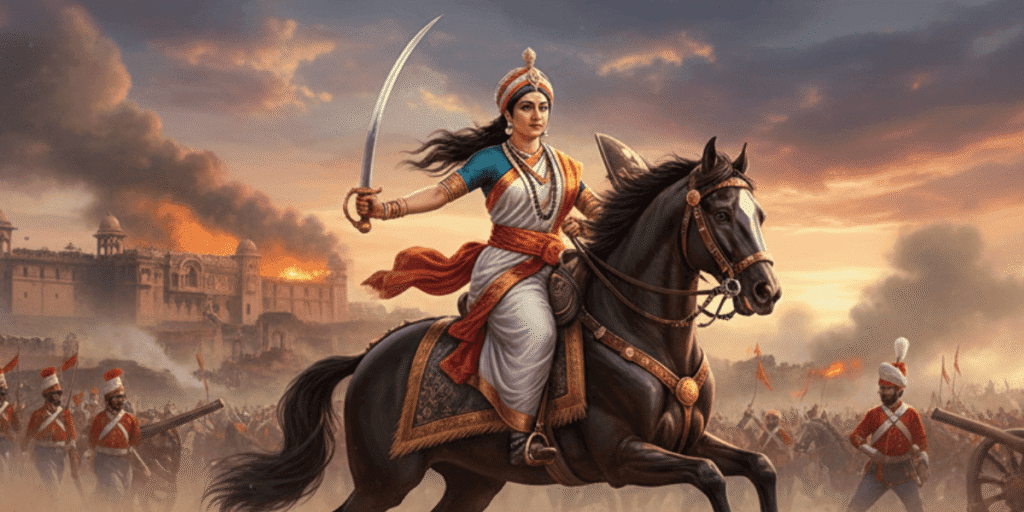
Below are 10 essential points about Rani Laxmi Bai, followed by detailed insights and frequently asked questions to help you get complete information in simple language.
10 Points About Rani Laxmi Bai – Queen of Jhansi
- Birth and Early Life: Rani Laxmi Bai was born on November 19, 1828, in Varanasi (Kashi). Her birth name was Manikarnika Tambe, and she was affectionately called “Manu.”
- Unconventional Education: Unlike other girls of her time, she was raised by her father, Moropant Tambe, in the court of the Peshwa. She was trained in martial arts, sword fighting, horse riding, and shooting.
- Marriage to the King: In 1842, she married the Maharaja of Jhansi, Gangadhar Rao Newalkar, and was given the name “Lakshmi Bai” in honor of the Goddess Lakshmi.
- The Tragedy of Her Heir: She gave birth to a son, Damodar Rao, who died after four months. Later, the couple adopted a son, Anand Rao (renamed Damodar Rao), to be the heir to the throne.
- The Doctrine of Lapse: After her husband’s death in 1853, the British Governor-General Lord Dalhousie refused to recognize her adopted son as the legal heir. He applied the “Doctrine of Lapse” to annex (take over) the Kingdom of Jhansi.
- The Historic Refusal: When the British ordered her to leave the fort, she famously declared, “Main apni Jhansi nahi dungi” (I shall not surrender my Jhansi). This became the slogan of her resistance.
- Role in the 1857 Revolt: She became a key leader in the Indian Rebellion of 1857. She assembled an army of both men and women, with her close aides like Jhalkari Bai helping her lead the troops.
- The Legendary Escape: When the British army led by Sir Hugh Rose besieged Jhansi in 1858, she made a daring escape from the fort on horseback, with her adopted son tied to her back. Her legendary horse, Baadal, is said to have died saving her during this jump.
- The Final Battle: Rani Laxmi Bai joined forces with Tatya Tope and other rebels to capture the Gwalior Fort. She fought her last battle at Kotah-ki-Serai near Gwalior on June 18, 1858, dressing as a soldier (sowar).
- A Hero’s Legacy: She died a martyr at the young age of 29. Even her enemy, Sir Hugh Rose, described her as “the most dangerous of all Indian leaders” and “the best and bravest of the rebels.”
Biography of Rani Laxmi Bai
Who was Rani Lakshmi Bai?
Rani Lakshmi Bai, originally named Manikarnika Tambe, is one of the most celebrated figures in Indian history. Popularly known as the “Rani of Jhansi,” she was a leading figure in the Indian Rebellion of 1857. She is remembered not just as a queen, but as a warrior who fiercely resisted the British East India Company to protect her people and her land.
1. Early Life and Upbringing
- Birth: She was born in 1828 (some historical records suggest 1835) in the holy city of Varanasi.
- Childhood: Her father worked under Peshwa Baji Rao II. She lost her mother at the tender age of four, which made her independent from a very young age.
- Unique Education: Unlike other girls of her time who were taught domestic chores, Manikarnika (nicknamed “Manu”) received an unusual upbringing. She was trained in martial arts, swordsmanship, horse riding, fencing, and Mallakhamb. She was also literate, having learned to read and write at home.
- Marriage: In 1842, she married Gangadhar Rao Newalkar, the Maharaja of Jhansi, and was subsequently renamed Lakshmi Bai.
2. The History of Her Struggle
- The Turning Point: Her life took a tragic turn when her husband died in 1853. Before his death, they had adopted a son, Damodar Rao, as their natural heir had died in infancy.
- British Oppression: The British Governor-General Lord Dalhousie refused to recognize the adopted heir. He applied the “Doctrine of Lapse,” a policy that allowed the British to take over any kingdom without a direct male heir.
- The Resistance: Determined to protect her rights, Rani Lakshmi Bai refused to surrender her kingdom. She famously stood her ground, declaring that she would not give up her Jhansi.
3. Last Stand and Legacy
- The Battle: In 1858, she led her troops into a fierce battle against British forces. Despite the rebellion ultimately being crushed, her leadership was exemplary.
- Martyrdom: She died fighting near Gwalior on June 18, 1858. She fought bravely until her last breath, dressing as a soldier to lead her army from the front.
- Enduring Legacy: Today, she is a symbol of Indian resistance and women’s empowerment. Her courage continues to inspire generations, proving that determination can challenge even the mightiest empires.
Rani Laxmi Bai: The Story Behind the Legend
While the 10 points above give you a summary, the details of her life reveal why Rani Lakshmi Bai Jayanti is celebrated with such pride across India.
Rani Laxmi Bai was not your typical queen of the 19th century. She did not live ‘purdah’ and was a warrior by birth and upbringing. During her childhood, she was friends with Nana Sahib and Tatya Tope.
Rani Laxmi Bai trained in the art of war with them and that training allowed her to protect her kingdom from the powerful British East India Company when it invaded her territory.
The War Strategy Rani Laxmi Bai didn’t just fight; she governed. She set up a foundry to cast cannons and trained a special women’s unit called the Durga Dal. This was revolutionary for that era. Her intelligence was as sharp as her sword; she managed to hold off the British forces for two weeks at Jhansi despite being outnumbered.
The Ultimate Sacrifice Her death was not just a loss for Jhansi but a spark for the entire nation. She refused to surrender or be captured alive. According to local legends, when she was critically wounded, she asked a hermit to burn her body immediately so the British could not touch her even in death.
Essay on Rani Laxmi Bai for Students
The Fearless Queen of Jhansi
Rani Laxmi Bai is one of the greatest freedom fighters of India. She is known as the “Queen of Jhansi” and is a symbol of bravery and patriotism. Her real name was Manikarnika, and she was affectionately called “Manu” in her childhood. She played a major role in the Revolt of 1857, which was India’s first war of independence.
Rani Laxmi Bai was born on November 19, 1828, in Varanasi, India. Unlike most girls her age, she did not play with dolls. Instead, she was taught how to ride horses, gather swords, shoot and take other warrior-type classes to become a soldier.
She was a very courageous and intelligent woman who married Gangadhar Rao the King of Jhansi, becoming the Queen of Jhansi.
After her husband’s death, the British attempted to take over the Kingdom of Jhansi through an underhanded manoeuvred government tactic known as the “Doctrine of Lapse” by denying her the right to have her adopted son, Damodar Rao, inherit the throne after her husband’s death.
Rani Laxmi Bai felt angered by this and determined to fight and retain her rights to rule and govern Jhansi. “I will not give up my Jhansi”.
Her Bravery and Sacrifice When the British army attacked Jhansi, she fought like a tigress. She tied her son to her back and rode her horse, Baadal, into the battlefield. She led her army with great courage. She fought her last battle in Gwalior and sacrificed her life for the country on June 18, 1858.
Conclusion
Rani Laxmi Bai proved that women are as strong and brave as men. She died young, but her story lives on in our hearts. She inspires every Indian student to love their country and fight against injustice. As the famous poem goes, “Khoob ladi mardani woh toh Jhansi wali Rani thi.”
Author’s Message
“Hello Readers!
Writing about Rani Laxmi Bai is always an emotional journey. As we dive into the facts of her life, it is easy to get lost in the dates and battles, but I hope this article helped you feel the spirit of her bravery.
My goal was to provide you with the most accurate, simple, and exam-ready points about her life without overwhelming you with unnecessary details. History is not just about the past; it is about finding inspiration for our future.
If you found this article helpful for your studies or general knowledge, please share it with your friends and family. Let’s keep the stories of our brave freedom fighters alive!
-Sahil Sethi
Read More:-
Top 10 Powerful Kings in India
Conclusion: The Legacy of the Warrior Queen
Rani Laxmi Bai’s life was short, but her impact on Indian history is everlasting. She proved that patriotism and courage have no gender. By refusing to bow down to the powerful British Empire, she lit the spark of freedom that eventually led to India’s independence in 1947.
Her story is not just a chapter in a textbook; it is a timeless lesson in resilience. Whether you are a student or a working professional, the life of the “Queen of Jhansi” teaches us one vital lesson: Fight for what is rightfully yours and never give up on your principles.
She remains a true symbol of women’s empowerment and a national hero whose name will be chanted with pride for generations to come.
Frequently Asked Questions (FAQs)
Q1: What are 10 lines on Rani Lakshmi Bai in Hindi?
A: Many users search for this. Here is a brief translation:
1. रानी लक्ष्मीबाई का जन्म 19 नवंबर 1828 को वाराणसी में हुआ था।
2. उनके बचपन का नाम मणिकर्णिका था और उन्हें ‘मनु’ कहा जाता था।
3. उनका विवाह झाँसी के राजा गंगाधर राव से हुआ था।
4. उन्होंने 1857 के स्वतंत्रता संग्राम में महत्वपूर्ण भूमिका निभाई।
5. उन्होंने अंग्रेजों के खिलाफ “मैं अपनी झाँसी नहीं दूँगी” का नारा दिया।
6. वह घुड़सवारी और तलवारबाजी में निपुण थीं।
7. उन्होंने अपने दत्तक पुत्र दामोदर राव को पीठ पर बांधकर युद्ध किया।
8. उनका घोड़ा ‘बादल’ उनकी वीरता का गवाह बना।
9. 18 जून 1858 को ग्वालियर में अंग्रेजों से लड़ते हुए वे शहीद हो गईं।
10. वह भारतीय इतिहास में “झाँसी की रानी” के नाम से अमर हैं।
Q2: Who was the husband of Rani Laxmi Bai?
A: Her husband was Maharaja Gangadhar Rao Newalkar, the King of Jhansi.
Q3: What happened to Rani Laxmi Bai’s son?
A: Her biological son died in infancy. Her adopted son, Damodar Rao, survived the war. After the Queen’s death, he lived a life of struggle on a small pension from the British but survived to continue the lineage.
Q4: Which British officer defeated Rani Laxmi Bai?
A: Sir Hugh Rose was the British General who besieged Jhansi and defeated the rebel forces in Gwalior.
Q5: Why is Rani Lakshmi Bai Jayanti celebrated?
A: It is celebrated on November 19th every year to mark her birth anniversary and honor her contribution to India’s freedom struggle and women’s empowerment.