
If you’ve ever wondered why some numbers feel “busier” than others – divisible by many different values. You’ve already touched the idea of composite numbers. Whether you’re a student preparing for an exam or someone who just wants to understand math better, this guide covers everything clearly and simply.
What Are Composite Numbers?
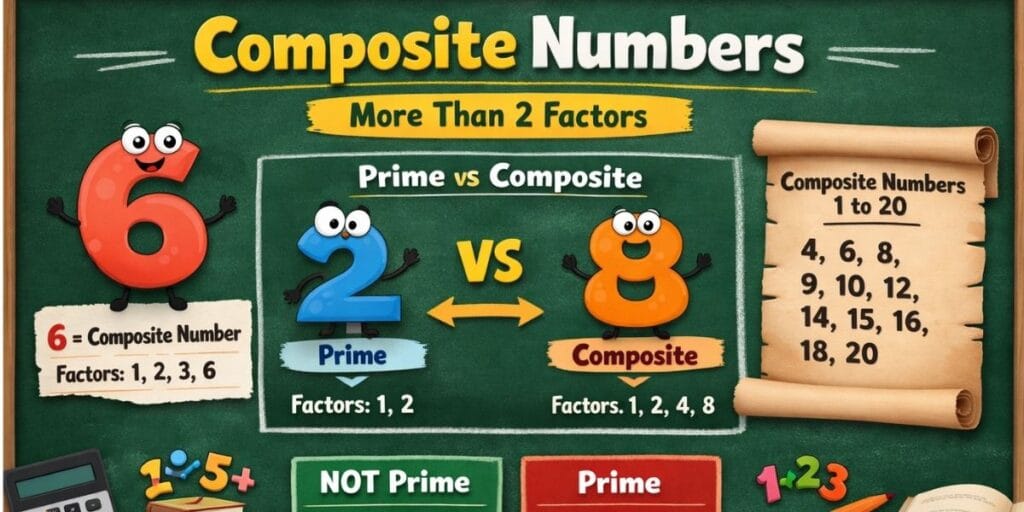
A composite number is any natural number greater than 1 that has more than two factors. In other words, it can be divided evenly by at least one number other than 1 and itself.
Simple way to remember it: If a number has more than two factors → it’s composite. If it has exactly two factors → it’s prime.
Example: Take the number 12. Its factors are: 1, 2, 3, 4, 6, and 12. Since 12 has more than two factors, it is a composite number.
Compare this with 7, which has only two factors: 1 and 7 – making it a prime number.
What Is the Smallest Composite Number?
The smallest composite number is 4.
Here’s why, step by step:
- 1 → Has only one factor (itself). Neither prime nor composite.
- 2 → Has exactly two factors: 1 and 2. It is prime.
- 3 → Has exactly two factors: 1 and 3. It is prime.
- 4 → Has three factors: 1, 2, and 4. It has more than two factors. Composite!
So 4 is the first and smallest composite number, and 6 comes right after it.
| Category | Number |
| Smallest composite number | 4 |
| Smallest odd composite number | 9 |
| Smallest two-digit composite number | 10 |
| Smallest three-digit composite number | 100 |
| Smallest prime number | 2 |
What Is the Smallest Odd Composite Number?
The smallest odd composite number is 9.
Why not 4, 6, or 8? Because those are even numbers. Why not 3, 5, or 7? Because those are prime numbers (only 2 factors each).
When we reach 9, we find: factors are 1, 3, and 9 – that’s three factors, making 9 the smallest odd composite number.
Types of Composite Numbers
1. Even Composite Numbers
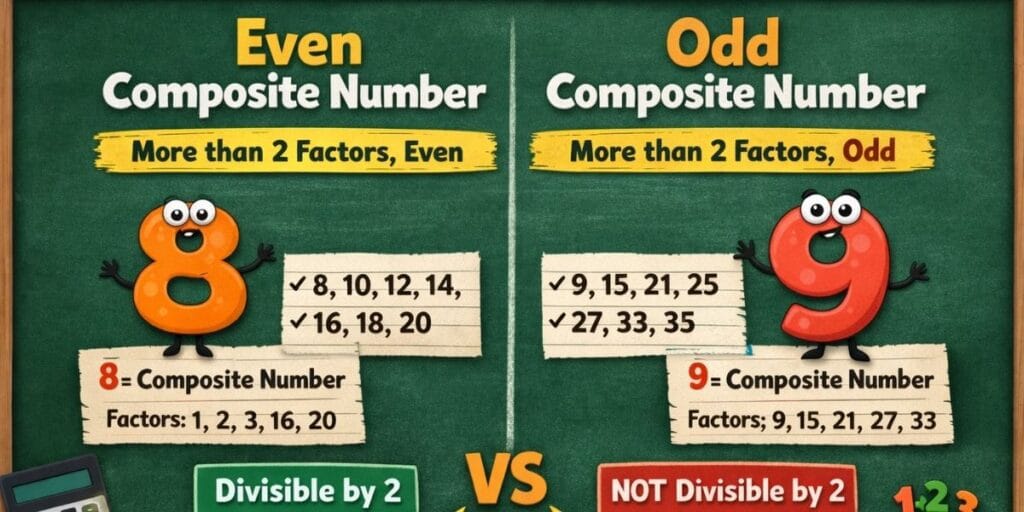
All even numbers greater than 2 are composite. They are divisible by 2 along with other numbers.
Examples: 4, 6, 8, 10, 12, 14, 16 …
2. Odd Composite Numbers
Odd numbers that are not prime fall into this category. They are not divisible by 2.
Examples: 9, 15, 21, 25, 27, 33, 35 …
List of Composite Numbers from 1 to 100
There are 74 composite numbers between 1 and 100. Here is the full list:
4, 6, 8, 9, 10, 12, 14, 15, 16, 18, 20, 21, 22, 24, 25, 26, 27, 28, 30, 32, 33, 34, 35, 36, 38, 39, 40, 42, 44, 45, 46, 48, 49, 50, 51, 52, 54, 55, 56, 57, 58, 60, 62, 63, 64, 65, 66, 68, 69, 70, 72, 74, 75, 76, 77, 78, 80, 81, 82, 84, 85, 86, 87, 88, 90, 91, 92, 93, 94, 95, 96, 98, 99, 100
Odd composite numbers (1–100): 9, 15, 21, 25, 27, 33, 35, 39, 45, 49, 51, 55, 57, 63, 65, 69, 75, 77, 81, 85, 87, 91, 93, 95, 99
Even composite numbers (1–100): 4, 6, 8, 10, 12 … all even numbers from 4 to 100 (except none – every even number above 2 is composite)
Composite Numbers from 1 to 1000 (Overview)
The pattern continues well beyond 100. Between 1 and 1000, there are 831 composite numbers in total. A few highlights:
| Smallest Composite Numbers Table | ||||
| Smallest 1 digit composite numbers | Smallest 2 digit composite numbers | Smallest 3 digit composite number | Smallest 4 digit composite numbers | |
| Odd | 9 | 15 | 105 | 1001 |
| Even | 4 | 10 | 100 | 1000 |
- There are 332 odd composite numbers from 1 to 1000
- There are 499 even composite numbers from 1 to 1000
- The smallest is still 4 and the largest in this range is 1000
Some examples: 102, 104, 105, 110, 111, 115, 119, 121, 125, 128, 133 … and so on.
How to Check If a Number Is Composite (Step-by-Step)
You don’t need to memorize lists. Just follow these simple steps:
Step 1: Find the factors of the number. Step 2: Count how many factors it has. Step 3: If the number has more than 2 factors → it’s composite.
Example: Is 21 a composite number? Factors of 21: 1, 3, 7, 21 That’s 4 factors → Yes, 21 is composite.
Example: Is 17 a composite number? Factors of 17: 1, 17 Only 2 factors → No, 17 is prime.
Why Is 13233343563715 a Composite Number?
This is a common exam question, and the answer is simpler than it looks!
Look at the last digit of 13233343563715. It ends in 5.
Any number that ends in 0 or 5 is always divisible by 5. So 13233343563715 ÷ 5 gives a whole number – meaning 5 is a factor of it, in addition to 1 and the number itself.
Since it has more than two factors, 13233343563715 is a composite number. You don’t need a calculator – just check the last digit!
Prime Numbers vs. Composite Numbers – What’s the Difference?
| Key Indicators | Prime Numbers | Composite Numbers |
| Factors | Exactly 2 (1 and itself) | More than 2 |
| Smallest | 2 | 4 |
| Examples | 2, 3, 5, 7, 11, 13 | 4, 6, 8, 9, 10, 12 |
| Even ones | Only 2 | All even numbers > 2 |
| Odd ones | Many (3, 5, 7, 11…) | Starting from 9 |
| Is 1 included? | No | No |
Key Properties of Composite Numbers
Here are the most important things to remember:
- Every composite number has at least 3 factors.
- Every composite number has at least one prime number as a factor.
- The number 1 is neither prime nor composite.
- 2 is the only even prime number; all other even numbers are composite.
- There is no largest composite number – they go on forever.
- Adding or subtracting two even composite numbers always gives an even composite number (e.g., 8 + 6 = 14).
Conclusion
Composite numbers are not complicated once you understand the core idea: any natural number greater than 1 that has more than two factors is a composite number. The best way to master composite numbers is to practice finding factors. Once you can quickly list a number’s factors, identifying whether it’s prime or composite becomes effortless – no memorization required.
Whether you’re preparing for a school test, a competitive exam, or just building a stronger foundation in mathematics, understanding composite numbers is a fundamental step. They appear everywhere in fractions, algebra, number theory, and real-world problem solving.
Keep it simple: more than two factors = composite. That one rule is all you need.
Read More:-
prime numbers between 1 to 100
Frequently Asked Questions (FAQs)
Q1. What is a composite number?
A composite number is a natural number greater than 1 that has more than two factors meaning it can be divided by at least one number other than 1 and itself.
Q2. What is the smallest composite number?
The smallest composite number is 4, because it has three factors: 1, 2, and 4.
Q3. What is the least composite number?
The least (smallest) composite number is 4. The terms “least” and “smallest” mean the same thing here.
Q4. What is the smallest odd composite number?
The smallest odd composite number is 9, with factors 1, 3, and 9.
Q5. Is 1 a composite number?
No. The number 1 has only one factor (itself), so it is neither prime nor composite.
Q6. Is 2 a composite number?
No. The number 1 has only one factor (itself), so it is neither prime nor composite.
Q7. How many composite numbers are there from 1 to 100?
There are 74 composite numbers from 1 to 100.
Q8. Why is 13233343563715 a composite number?
Because it ends in 5, which means it is divisible by 5. Any number divisible by a value other than 1 and itself is composite.
Q9. Are all even numbers composite?
Almost except 2, which is prime. Every even number greater than 2 is composite.
Q10. What are the first five composite numbers?
The first five composite numbers are 4, 6, 8, 9, and 10.