
Have you ever wondered how an eye specialist knows exactly what kind of Glass will fix your vision? Or how camera manufacturers design lenses that can zoom in on a bird miles away? The secret lies in a powerful mathematical tool called the Lens Maker Formula.
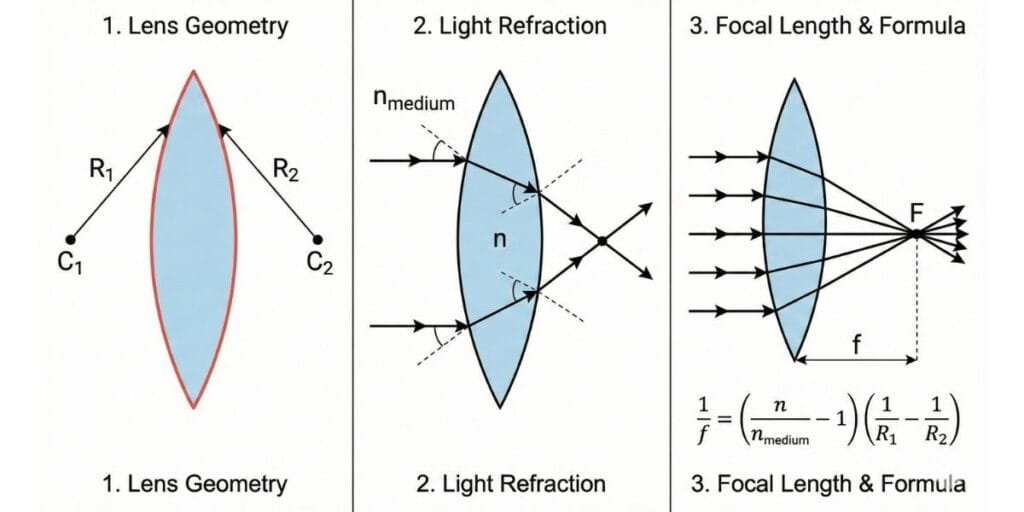
In this guide, we will break down the Lens Maker’s formula in the simplest way possible. Whether you are a student preparing for exams like JEE or NEET, or just a curious mind, you’ll find everything you need to know right here.
What Exactly is the Lens Maker Formula?
In simple terms, the Lens Maker Formula is a relation that links the focal length of a lens to the material it is made of (refractive index) and its physical shape (the curvature of its surfaces).
If you are a manufacturer (a “lens maker”), you use this formula to determine how curved the glass should be to achieve a specific power or focal length.
The Formula:
- : Focal length of the lens.
- : Refractive index of the lens material (relative to the medium).
- : Radius of curvature of the first surface.
- : Radius of curvature of the second surface.
Lens Maker Formula Derivation: Step-by-Step
Many students find the lens maker formula derivation intimidating, but it’s actually just a two-step process. We look at how light bends (refracts) at the first surface and then how it bends again at the second surface.
Assumptions for the Derivation:
To keep things simple, we assume:
- The lens is thin (the distance between the two surfaces is negligible).
- The object is a point object placed on the principal axis.
- The rays of light are paraxial (close to the axis).
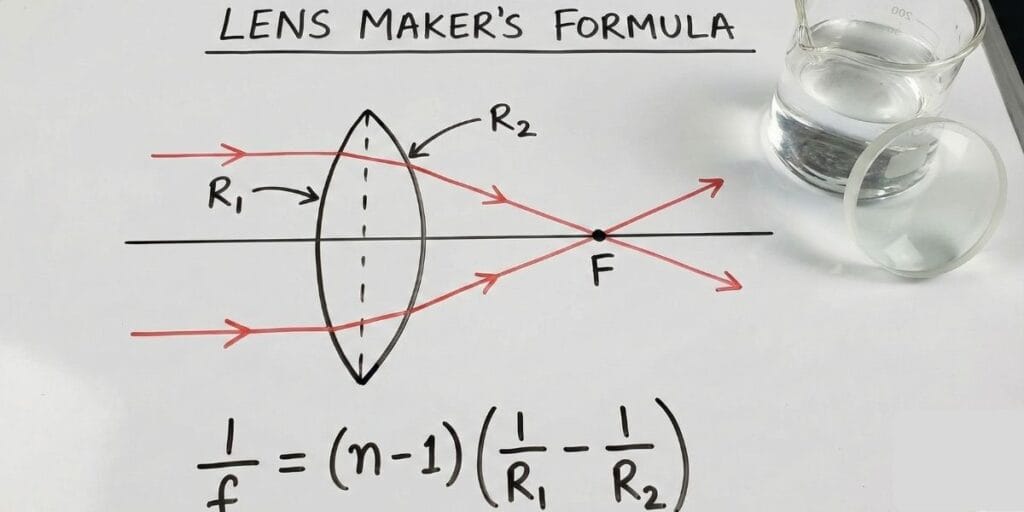
Step 1: Refraction at the First Surface
Imagine light hitting the first surface with radius . Using the formula for refraction at a spherical surface:
Here, is the image formed by the first surface, which acts as a “virtual object” for the second surface.
Step 2: Refraction at the Second Surface
Now, the light passes through the second surface ():
Step 3: Combining the Equations
When we add these two equations together, the term cancels out. After simplifying, we get:
Since (from the lens formula), we arrive at the final lens maker’s formula.
How Does the Lens Maker Formula Change for a Concave Lens?
While the base formula remains the same, the lens maker formula for concave lens calculations depends heavily on Sign Convention.
- For a Convex Lens: is positive and is negative. This makes the focal length () positive.
- For a Concave Lens: is negative and is positive. When you plug these into the formula, you get a negative focal length (), which confirms that concave lenses are “diverging” lenses.
Why is this Formula so Important?
This isn’t just a classroom equation; it has real-world applications:
- Corrective Eyewear: Opticians use it to design glasses for nearsightedness and farsightedness.
- Microscopes & Telescopes: Engineers calculate the exact curvature needed to magnify tiny cells or distant stars.
- Camera Lenses: High-end photography depends on the precise calculation of focal lengths using different glass materials.
Lens Maker’s Formula Assumptions
To ensure your calculations remain accurate and SEO-friendly for your readers, here is the breakdown of why these assumptions are necessary:
· Thin Lens: The lens is assumed to be very thin, meaning the thickness of the lens is negligible compared to its radii of curvature.
· Measurement Origin: All distances (object distance, image distance, radii of curvature) are measured from the optical center of the lens.
· Small Aperture: The aperture (the opening through which light passes) of the lens is considered to be small.
· Point Object: The object from which light rays originate is assumed to be a point-sized object.
· Paraxial Rays: The angles that the incident rays and refracted rays make with the principal axis are assumed to be very small. This means the rays are close to the principal axis.
Common Mistakes to Avoid
To ensure you get the right answer in your exams or projects, keep these “pro-tips” in mind:
- The Medium Matters: The value of is the refractive index of the lens relative to the surrounding medium. If you dunk a glass lens in water, its focal length will change!
- Watch the Signs: Always use the Cartesian sign convention. If you get the plus/minus signs for and wrong, your entire calculation will flip.
- Thin Lens Only: Remember, this formula is an approximation for thin lenses. For very thick lenses, the math gets much more complex.
Author’s Message
In my experience with physics, I know that Ray Optics can often feel intimidating. It’s easy to get lost in the jungle of ray diagrams, sign conventions, and derivations. That’s exactly why I prepared this content to break down these complex ideas into simple, logical steps that you can actually use, whether you are tackling boards or preparing for competitive exams like JEE or NEET.
Remember, the goal isn’t just to memorize the formula, but to understand the magic behind it: how we use mathematics to design tools that help us see the world better. Keep practicing, pay close attention to your sign conventions, and stay curious.
-Sahil Sethi.
Read More
Prime Numbers Between 1 to 100
Conclusion
The Lens Maker Formula is the bridge between physics theory and the practical technology we use to see the world better. By understanding the relationship between material and shape, we can manipulate light to our advantage.
If you found this guide helpful, share it with a classmate who’s struggling with physics!
Frequently Asked Questions (FAQs)
Q1. Why is it called the Lens Maker’s Formula?
It is called so because it provides the necessary specifications (radii of curvature) to a lens manufacturer to create a lens of a desired focal length using a specific material.
Q2. What is the difference between the Lens Formula and the Lens Maker Formula?
Lens Formula () relates the object distance, image distance, and focal length.
Lens Maker Formula relates the focal length to the physical properties of the lens (refractive index and radii of curvature).
Q3. Does the focal length of a lens change in water?
Yes! Since the refractive index () is relative to the medium, the focal length increases when a lens is placed in a medium like water (which has a higher refractive index than air).
Q4. What are the limitations of the Lens Maker Formula?
The formula only works for thin lenses. It also assumes that the light rays are paraxial (close to the principal axis) and that the lens has a small aperture.
Q5. What happens if for a biconvex lens?
If the radii are equal ( and ), the formula simplifies to: