
India is often called a land of contrasts, and nothing proves this better than the seasons of India. While most of the world operates on a simple four-season cycle, India’s climate is a unique blend of scientific weather patterns and ancient cultural traditions.
If you have ever wondered, “India has how many seasons in an year?”, the answer might surprise you. Depending on who you ask a meteorologist or a priest – the answer changes.
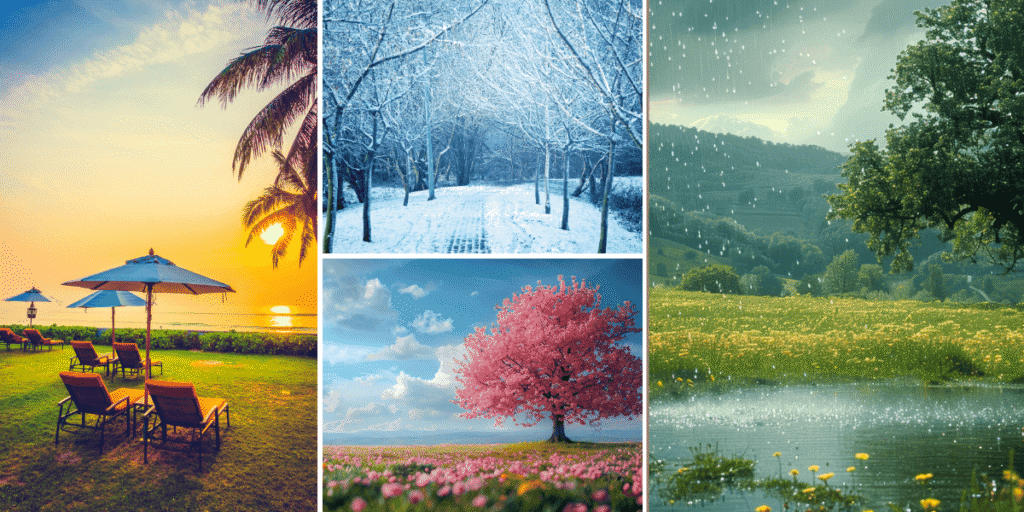
This guide simplifies the seasons in India, covering the official classifications, the traditional “Ritus,” and how these seasons shape the life, festivals, and food of the country.
How Many Seasons Are There in India?
To understand the climate of India, we must look at it through two different lenses:
- The Official Approach (IMD): The India Meteorological Department (IMD) classifies India into 4 distinct seasons.
- The Traditional Approach (Ayurveda/Hindu Calendar): Indian culture divides the year into 6 seasons, known as Ritus.
Let’s explore both to give you a complete picture.
The 4 Official Seasons of India
The India Meteorological Department (IMD) follows a system based on monsoon winds and temperature changes. This is the standard used for weather forecasting and geography.
1. Winter Season (Cold Weather Season)
- Months: December to February
- Characteristics: The days are pleasant, but nights can get quite cold, especially in Northern India (Delhi, Punjab, Himachal Pradesh). Southern India remains mild and pleasant.
- Key Feature: Snowfall in the Himalayas and dry weather in the plains.
2. Summer Season (Pre-Monsoon Season)
- Months: March to May
- Characteristics: As the sun moves towards the Tropic of Cancer, temperatures soar. Central and Western India often see temperatures rising above 40°C (104°F).
- Key Feature: The “Loo” a hot, dry wind that blows across North India.
3. Monsoon Season (Southwest Monsoon)
- Months: June to September
- Characteristics: This is the most critical season for India’s economy. The monsoon winds enter from Kerala and cover the entire country by July.
- Key Feature: Heavy rainfall that brings relief from the heat and waters the crops (Kharif crops).
4. Autumn / Post-Monsoon Season (Retreating Monsoon)
- Months: October and November
- Characteristics: The monsoon winds retreat (go back). The sky becomes clear, and the humidity drops, setting the stage for winter.
- Key Feature: Tamil Nadu and Andhra Pradesh receive heavy rainfall during this time due to the Northeast Monsoon.
The 6 Traditional Seasons of India (The Ritus)
While the IMD focuses on weather, the Indian heart beats to the rhythm of the Ritus. Ancient texts and the Hindu calendar divide the year into six two-month periods. This is what makes the seasons of India truly unique.
| Seasons in India | Ritu (Sanskrit/Hindi) | Months (Approx.) | What Makes it Special? |
| Spring | Vasant Ritu | mid-Feb to mid-April | Known as the “King of Seasons.” Trees bear new leaves, and the weather is perfect.. |
| Summer | Grishma Ritu | mid-April to mid-June | The hottest time of the year. Rivers dry up, and schools close for holidays. |
| Monsoon | Varsha Ritu | mid-June to mid-Aug | The arrival of rain brings life. The surroundings turn lush green. |
| Autumn | Sharad Ritu | mid-Aug to mid-Oct | The skies clear up, and the moon looks brightest. It is the season of festivities. |
| Pre-Winter | Hemant Ritu | mid-Oct to mid-Dec | The air gets crisp and pleasant. It is considered the healthiest season. |
| Winter | Shishir Ritu | mid-Dec to mid-Feb | The peak of winter with foggy mornings and chilly winds. |
1. Vasant Ritu (Spring)
- Time: Mid-February to Mid-April.
- Description: Often called the “King of Seasons,” this is considered the most pleasant time of the year. The bitter cold fades away, trees sprout new leaves, and flowers bloom. The temperature is moderate neither too hot nor too cold.
- Key Festivals: Holi, Vasant Panchami, Gudi Padwa.
2. Grishma Ritu (Summer)
- Time: Mid-April to Mid-June.
- Description: This is the hottest season in India. The sun is intense, water bodies begin to dry up, and the heat can be scorching. In many parts of North India, hot dry winds known as “Loo” blow during the day.how many seasons are there in india
- Key Festivals: Baisakhi, Buddha Purnima.
3. Varsha Ritu (Monsoon)
- Time: Mid-June to Mid-August.
- Description: This season brings relief from the summer heat with heavy rainfall. The landscape turns lush green, and river levels rise. It is the most critical season for farmers as they sow their Kharif crops.
- Key Festivals: Raksha Bandhan, Janmashtami.
4. Sharad Ritu (Autumn)
- Time: Mid-August to Mid-October.
- Description: This is the transition period when the monsoon retreats. The sky becomes clear blue, and the weather is mild and beautiful. It is often associated with the blooming of white Kash flowers and bright moonlit nights.
- Key Festivals: Navratri, Durga Puja, Dussehra.
5. Hemant Ritu (Pre-Winter)
- Time: Mid-October to Mid-December.
- Description: This marks the beginning of winter. The temperature starts dropping gradually, making the days very pleasant and the nights cool. It is often considered the healthiest season of the year.
- Key Festivals: Diwali, Bhai Dooj, Karthik Purnima.
6. Shishir Ritu (Winter)
- Time: Mid-December to Mid-February.
- Description: This is the peak winter season. The weather is at its coldest, often accompanied by heavy fog in North India and snowfall in the Himalayan regions. People wear heavy woolens, and crops like wheat ripen.
- Key Festivals: Lohri, Makar Sankranti, Pongal, Republic Day.
Why Are the Seasons Important for Agriculture?
You cannot talk about seasons in India without talking about farming. Indian agriculture is the backbone of the economy, and it strictly follows the seasonal calendar.
- Kharif Crops (Monsoon Crops): Sown in June/July and harvested in September/October.
- Examples: Rice, Maize, Cotton.
- Rabi Crops (Winter Crops): Sown in October/November and harvested in April/May.
- Examples: Wheat, Mustard, Barley.
- Zaid Crops (Summer Crops): Grown in the short gap between Rabi and Kharif (March to June).
- Examples: Watermelon, Cucumber, Muskmelon.
Read More:-
Conclusion
The seasons of India are far more than just changes in temperature; they are the rhythm of life for over a billion people. While the meteorological department classifies the climate into four official seasons, the country’s heart beats to the traditional six-season Ritu cycle.
From the economic importance of the Monsoon for farmers to the cultural vibrancy of the festive Autumn, every season plays a unique role in shaping India’s identity. Whether you are tracking the weather for agriculture, travel, or festivals, understanding this diverse climate cycle helps you truly appreciate the rich geography and heritage of India.
Frequently Asked Questions (FAQs)
Q1: How many seasons are there in India?
Ans: Officially, there are 4 seasons (Winter, Summer, Monsoon, Post-Monsoon). However, traditionally and culturally, India celebrates 6 seasons (Vasant, Grishma, Varsha, Sharad, Hemant, Shishir).
Q2: Which is the longest season in India?
Ans: The Summer and Monsoon seasons are generally the longest, spanning roughly 3 to 4 months each depending on the region.
Q3: Why does India have a “Retreating Monsoon”?
Ans: Unlike most countries, India experiences rain twice in some parts. After drenching the country, the monsoon winds withdraw in October-November, causing the “Retreating Monsoon,” which brings rain specifically to the southeastern coast (like Chennai).
Q4: Which is the hottest month in India?
Ans: May is generally the hottest month for most of India, with temperatures often peaking above 40°C-45°C (104°F-113°F). However, in the west (like Rajasthan), June can also be extremely hot before the rains arrive.
Q5: Which is the coldest month in India?
Ans: January is typically the coldest month across the country. In Northern India, temperatures can drop near freezing (0°C–5°C), while Southern India remains pleasant (around 20°C–25°C).