
Have you ever wondered why everything around you has a shape? From the round clock on your wall to the rectangular door you walk through, shapes are literally everywhere! Whether you’re a student learning geometry, a parent teaching your child, or just curious about the world around you, understanding shapes and their names is more useful than you might think.
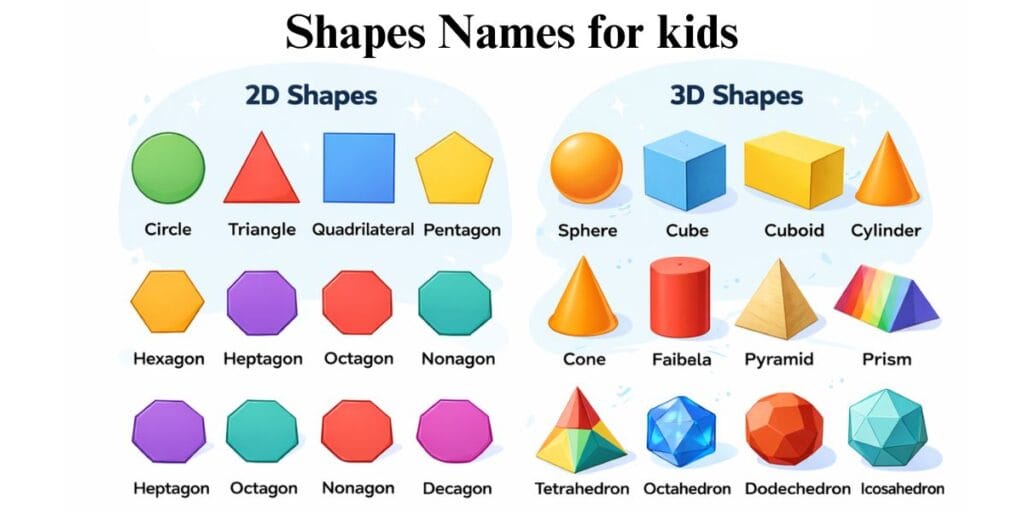
In this complete guide, we’ll explore everything about shapes – from basic 2D shapes like circles and squares to complex 3D shapes like dodecahedrons. We’ll keep things simple and helpful, so you can easily understand and remember each shape. Let’s dive in!
What Are Shapes?
A shape is the form or outline of an object. It tells us how something looks – whether it has straight lines, curved edges, corners, or faces. Shapes help us understand and describe the things we see every day.
Think about it: when you describe your room, you might say the table is rectangular, the clock is round, and the window is square. That’s the power of knowing shape names – it makes communication easier and more precise!
Why Learning Shapes Is Important
Learning shapes isn’t just about memorizing names. It’s about building essential skills that help in many areas of life:
- Math Foundation: Shapes are the building blocks of geometry and help you understand more complex mathematical concepts
- Observation Skills: Recognizing shapes improves how you see and understand your surroundings
- Problem-Solving: Understanding shapes helps in spatial reasoning and solving real-world problems
- Art and Design: Artists and designers use shapes to create everything from logos to buildings
- Everyday Life: From packing boxes to arranging furniture, shape knowledge makes daily tasks easier
Basic Shapes Name in English (Top 10 Must-Know Shapes)
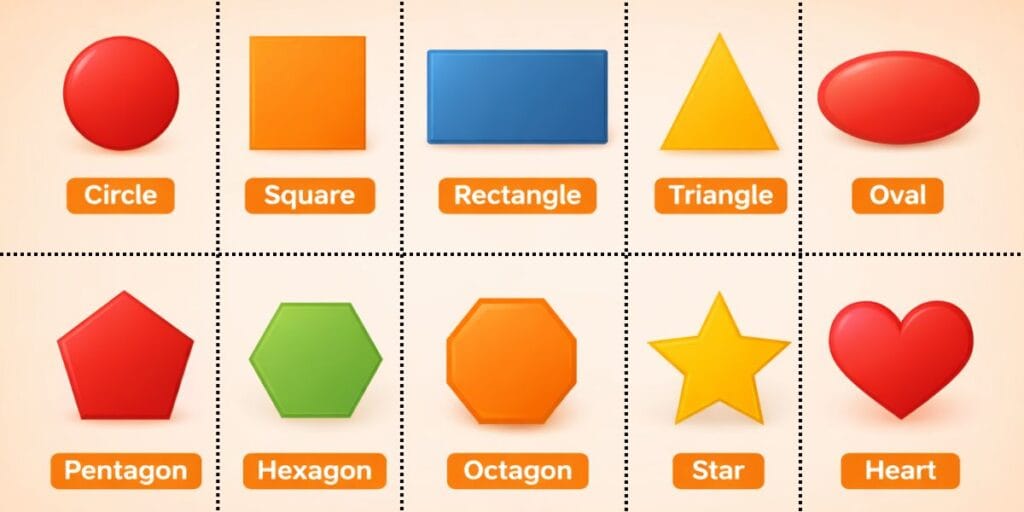
Let’s start with the 10 most common shapes you’ll see every single day. These are the foundational shapes that everyone should know:
| Shape Name | Description | Real-Life Examples |
| Circle | A round shape with no corners or edges. All points are the same distance from the center. | Clock, pizza, coins, wheels, sun |
| Square | Four equal sides and four right angles (90 degrees). Perfectly symmetrical. | Chess board, dice, window panes, tiles |
| Rectangle | Four sides with opposite sides equal. All corners are right angles. | Doors, books, smartphones, tables |
| Triangle | Three sides and three angles. The angles always add up to 180 degrees. | Pizza slice, traffic signs, pyramids, coat hangers |
| Oval | An elongated circle, like a stretched circle with smooth curves. | Eggs, mirrors, race tracks, balloons |
| Pentagon | Five sides and five angles. Interior angles add up to 540 degrees. | Pentagon building, home plate in baseball |
| Hexagon | Six sides and six angles. Interior angles add up to 720 degrees. | Honeycomb cells, nuts and bolts, floor tiles |
| Octagon | Eight sides and eight angles. Interior angles add up to 1080 degrees. | Stop signs, UFC fighting ring, umbrellas |
| Star | Pointed shape with multiple tips extending from a center. | Decorations, ratings, national flags |
| Heart | Two curved halves meeting at a point at the bottom. | Valentine decorations, love symbols, emojis |
All 2d Shapes Name (Two-Dimensional Shapes)
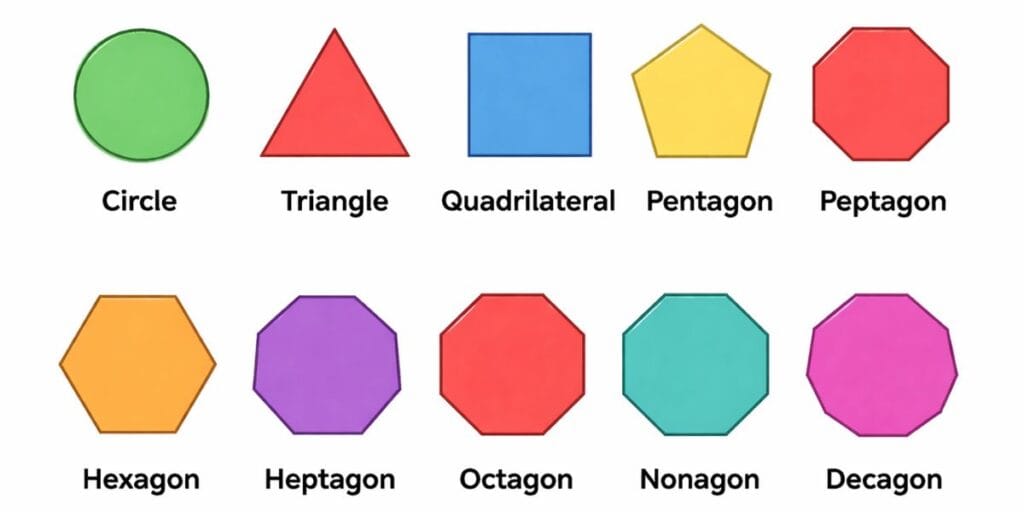
Two-dimensional shapes are flat shapes that have only length and width. They don’t have any thickness or depth. Think of them as shapes you can draw on paper.
What Makes a Shape 2D?
A 2D shape has these characteristics:
- Only two dimensions: length and width
- Flat surface (no depth or volume)
- Can be drawn on paper completely
- Has area (measured in square units)
Complete List of 2D Shapes Name in Maths
| Shape | Sides | Angles | Special Properties |
| Circle | 0 (curved) | 0 | All points equal distance from center |
| Triangle | 3 | 3 (sum = 180°) | Simplest polygon |
| Quadrilateral | 4 | 4 (sum = 360°) | Includes squares, rectangles, rhombus |
| Pentagon | 5 | 5 (sum = 540°) | Regular pentagon has equal sides |
| Hexagon | 6 | 6 (sum = 720°) | Common in nature (honeycomb) |
| Heptagon | 7 | 7 (sum = 900°) | Also called septagon |
| Octagon | 8 | 8 (sum = 1080°) | Used in stop signs |
| Nonagon | 9 | 9 (sum = 1260°) | Also called enneagon |
| Decagon | 10 | 10 (sum = 1440°) | Ten-sided polygon |
Special Types of 2D Shapes
Quadrilaterals (4-sided shapes): These deserve special mention because they’re so common in our daily lives:
- Square: All sides equal, all angles 90°
- Rectangle: Opposite sides equal, all angles 90°
- Rhombus: All sides equal, opposite angles equal
- Parallelogram: Opposite sides parallel and equal
- Trapezoid: One pair of parallel sides
- Kite: Two pairs of adjacent sides equal
Triangles (3-sided shapes): Classified by sides or angles:
- Equilateral Triangle: All three sides and angles equal (each angle is 60°)
- Isosceles Triangle: Two sides equal
- Scalene Triangle: All sides different lengths
- Right Triangle: One angle is exactly 90°
- Acute Triangle: All angles less than 90°
- Obtuse Triangle: One angle greater than 90°
All 3D Shapes Name (Three-Dimensional Shapes)
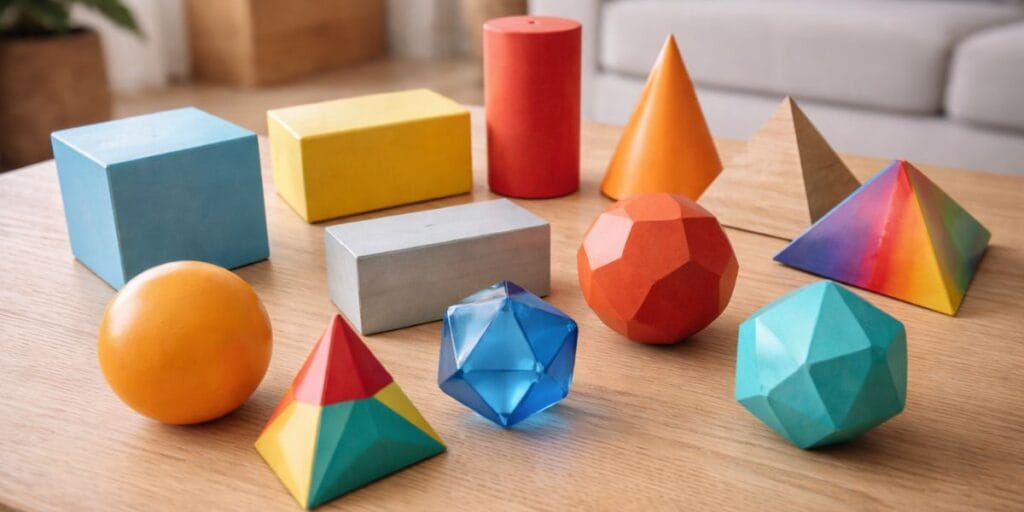
Three-dimensional shapes are solid objects that have length, width, and height. Unlike 2D shapes that you can only draw on paper, 3D shapes have volume and take up space in the real world. You can hold them, turn them around, and see them from different angles.
What Makes a Shape 3D?
A 3D shape has these characteristics:
- Three dimensions: length, width, and height
- Has volume (measured in cubic units)
- Takes up space in the real world
- Has faces, edges, and vertices (corners)
Complete List of 3D Shapes – All Shapes Name
| 3D Shape | Description | Real-Life Examples |
| Sphere | Perfectly round 3D shape. All points on surface are equal distance from center. | Basketball, globe, tennis ball, orange |
| Cube | Six equal square faces, 8 vertices, 12 edges. All sides are equal. | Dice, ice cube, Rubik’s cube, gift box |
| Cuboid | Six rectangular faces, 8 vertices, 12 edges. Like a stretched cube. | Book, shoe box, refrigerator, brick |
| Cylinder | Two circular bases connected by a curved surface. | Can, pipe, drum, battery, candle |
| Cone | Circular base with curved surface meeting at a point (apex). | Ice cream cone, party hat, traffic cone |
| Pyramid | Polygonal base with triangular faces meeting at apex. | Egyptian pyramids, tent, roof |
| Prism | Two identical polygonal bases with rectangular sides connecting them. | Toblerone chocolate, kaleidoscope, tent |
| Tetrahedron | 4 triangular faces, 4 vertices, 6 edges. | Pyramidal structures, molecular shapes |
| Octahedron | 8 equilateral triangular faces, 6 vertices, 12 edges. | Fluorite crystals, 8-sided dice |
| Dodecahedron | 12 pentagonal faces, 20 vertices, 30 edges. | 12-sided dice, geometric puzzles |
| Icosahedron | 20 equilateral triangular faces, 12 vertices, 30 edges. | 20-sided dice, virus structures |
What’s the Difference Between 2D and 3D Shapes?
This is one of the most common questions students ask, and it’s actually quite simple once you understand the basic concept. Let’s break it down:
| Feature | 2D Shapes | 3D Shapes |
| Dimensions | Two (length and width) | Three (length, width, and height) |
| Appearance | Flat (like a drawing) | Solid (like a real object) |
| Measurement | Has area (square units) | Has volume (cubic units) |
| Physical Existence | Cannot hold or touch (drawings) | Can hold and touch (real objects) |
| Properties | Has sides and angles | Has faces, edges, and vertices |
| Examples | Circle, square, triangle, rectangle | Sphere, cube, cylinder, cone |
Quick Memory Tip: Think of 2D shapes as pictures or drawings on paper, while 3D shapes are the actual objects you can pick up and hold!
Shapes Name in Maths: Understanding Geometry Basics
In mathematics, understanding shapes is the foundation of geometry. Here’s what you need to know about geometric shapes:
Important Mathematical Terms
- Polygon: A closed 2D shape with straight sides (triangles, squares, pentagons are polygons)
- Vertex (Vertices): The corner point where two or more edges meet
- Edge: The line segment where two faces meet in a 3D shape
- Face: The flat surface of a 3D shape
- Perimeter: The total distance around a 2D shape
- Area: The space inside a 2D shape (measured in square units)
- Volume: The space inside a 3D shape (measured in cubic units)
Regular vs Irregular Shapes
Regular Shapes: All sides and angles are equal (like a square or equilateral triangle)
Irregular Shapes: Sides and angles are not all equal (like a scalene triangle or irregular pentagon)
Shapes Name for Kids: Fun Ways to Learn
Teaching shapes to children doesn’t have to be boring! Here are some engaging methods to help kids learn and remember shape names:
1. Shape Hunt Game
Take your child on a shape hunt around the house or neighborhood. Ask them to find:
- Something circular (clock, plate, wheel)
- Something rectangular (door, book, phone)
- Something triangular (pizza slice, roof, hanger)
2. Create Shapes with Everyday Items
Use straws, toothpicks, or popsicle sticks to build different shapes. This hands-on activity helps children understand how shapes are formed.
3. Shape Tracing and Coloring
Give kids worksheets where they can trace shapes and color them. This builds fine motor skills while learning shape recognition.
4. Play-Dough Shapes
Let children mold different shapes using play-dough or clay. Creating 3D shapes from play-dough makes learning tactile and memorable.
5. Shape Songs and Rhymes
Simple songs about shapes help kids memorize names effortlessly. For example: ‘A circle is round, it has no end. A square has four sides, each one a friend!’
Conclusion: Mastering Shapes Opens Doors
Understanding shapes is more than just memorizing names – it’s about developing spatial awareness, problem-solving skills, and a deeper appreciation for the world around us. From the simple circle to complex polyhedrons, each shape has its unique properties and applications.
Whether you’re a student learning geometry, a parent teaching your child, or just someone curious about shapes, remember that practice makes perfect. Start with the basics, observe shapes in your daily life, and gradually move to more complex forms.
The world of shapes is fascinating and endless. Keep exploring, keep learning, and you’ll find that shapes are not just mathematical concepts – they’re the building blocks of everything we see and create!
Happy Learning!
Read More:-
Frequently Asked Questions
Q1. How many basic shapes should kids learn first?
Children should start with 6-10 basic shapes: circle, square, rectangle, triangle, oval, heart, star, pentagon, hexagon, and octagon. Once they master these, they can move on to more complex shapes.
Q2. At what age should children start learning shapes?
Children can begin recognizing simple shapes as early as 18 months to 2 years old. By age 3-4, they should be able to name basic shapes like circles, squares, and triangles.
Q3. What’s the easiest way to remember polygon names?
Remember these prefixes: tri = 3, quad = 4, penta = 5, hexa = 6, hepta = 7, octa = 8, nona = 9, deca = 10. Just count the sides and match the prefix!
Q4. Are there shapes with more than 10 sides?
Yes! An 11-sided shape is called a hendecagon, a 12-sided shape is a dodecagon, and a 20-sided shape is an icosagon. For shapes with many sides, we often just say ‘n-gon’ (like ’15-gon’ for a 15-sided shape).
Q5. What’s the difference between a rhombus and a square?
Both have four equal sides, but a square has four right angles (90 degrees each), while a rhombus can have different angle measurements. All squares are rhombuses, but not all rhombuses are squares!
Q6. Why do we need to learn about shapes?
Shapes are everywhere! Understanding shapes helps in mathematics, art, architecture, engineering, design, and even everyday tasks like packing, organizing, and navigating spaces.
Q7. What are the five Platonic solids?
The five Platonic solids are perfectly symmetrical 3D shapes: tetrahedron (4 faces), cube (6 faces), octahedron (8 faces), dodecahedron (12 faces), and icosahedron (20 faces).
Q8. Can a shape be both 2D and 3D?
No, a shape is either 2D or 3D. However, 2D shapes can be the faces of 3D shapes. For example, a cube has six square faces (the squares are 2D, the cube is 3D).
Q9. What’s the most common shape in nature?
Hexagons are incredibly common in nature! You’ll find them in honeycombs, snowflakes, turtle shells, and even some rock formations. Nature loves hexagons because they’re efficient at filling space.
Q10. How do I help my child who struggles with shape recognition?
Make it fun and practical! Use real objects, play shape-matching games, create art projects with shapes, and practice regularly. Every child learns at their own pace, so patience and encouragement are key.