
The story of the town planning of Indus Valley Civilization (IVC), or Harappan Civilization, is not just a tale of ancient people; it is the genesis of urban planning on the Indian subcontinent. Flourishing from approximately 3300 BCE to 1300 BCE, its great cities like Mohenjo-Daro and Harappa were not the result of organic sprawl, but of meticulous, almost hyper-modern, municipal foresight.
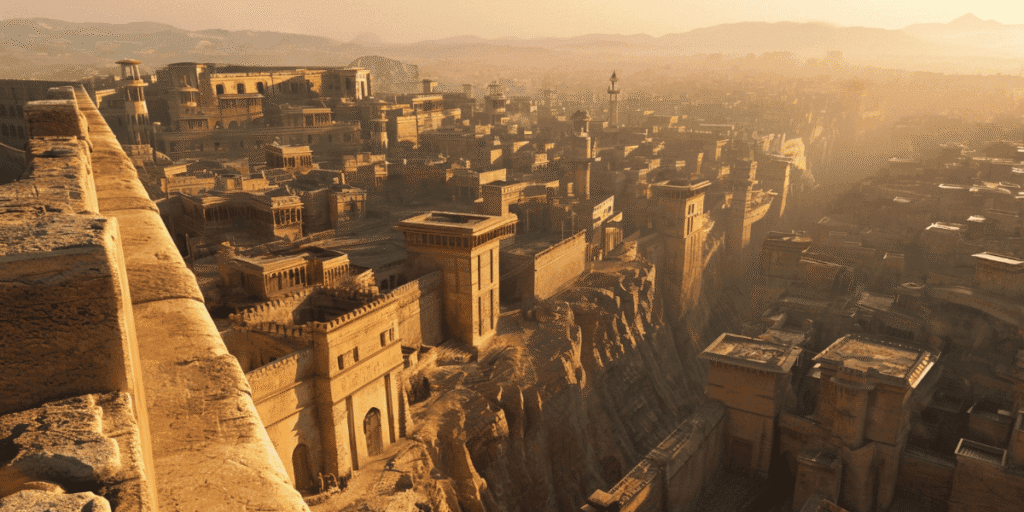
To delve into the Town planning of Indus Valley Civilization is to confront an architectural paradox: a Bronze Age society that seemingly possessed the blueprint for a contemporary metropolis. The sophistication, standardization, and singular focus on public utility exhibited by the Harappans stand unparalleled in the ancient world, revealing a society governed by a high degree of centralized planning and a profound respect for public health.
Here is an in-depth look at the structural insights that define this urban marvel.
Key Features of Town Planning of the Indus Valley Civilization | Harappan Community
1. The Geometry of Governance: The Grid System
The foundational feature of Harappan urbanism is its revolutionary grid pattern. This system of city layout was anything but accidental; it was a deliberate act of engineering that divided the settlements into well-defined, rectangular blocks.
- Checkerboard Layout: Main streets ran straight, predominantly oriented North-South and East-West, and consistently intersected one another at near-perfect right angles. This design facilitated easy navigation and superb ventilation, acting as a natural air conditioning system in the summer heat.
- Planned Thoroughfares: The major roads were impressive in width, often spanning 10 to 13 meters, wide enough to accommodate the movement of carts and pedestrians efficiently.
- Privacy and Practicality: In a remarkable display of civic consideration, house doors rarely opened directly onto the main thoroughfares. Instead, they faced narrow side lanes. This strategic choice reduced dust and noise pollution in the homes and likely contributed to traffic safety on the main arteries.
2. The Bipartite City: Citadel and Lower Town
Most Harappan cities were intentionally segregated into two principal sectors, suggesting a clear administrative and social hierarchy.
- The Citadel (Upper Town): Located to the west, this was the smaller, higher section of the city. It was built upon an elevated mud-brick podium or platform, which not only gave it an imposing presence but also served as a crucial defense against annual river floods. This area typically housed the structures related to governance, ritual, and large-scale public utility, such as the Great Bath and the Granaries.
- The Lower Town: This was the extensive, larger eastern section where the common citizens resided. It contained the densely packed, yet highly organized, residential blocks of baked-brick houses, all seamlessly integrated into the municipal drainage network.
3. An Obsession with Hygiene: The Closed Drainage System
Perhaps the most astonishing legacy of the IVC is its immaculate system of sanitation – A feature that often surpassed the drainage of European cities well into the 18th century.
- House-to-Street Connection: Every house had its own bathing area and a system of carefully built vertical and horizontal drains that channeled wastewater directly into the main street gutters.
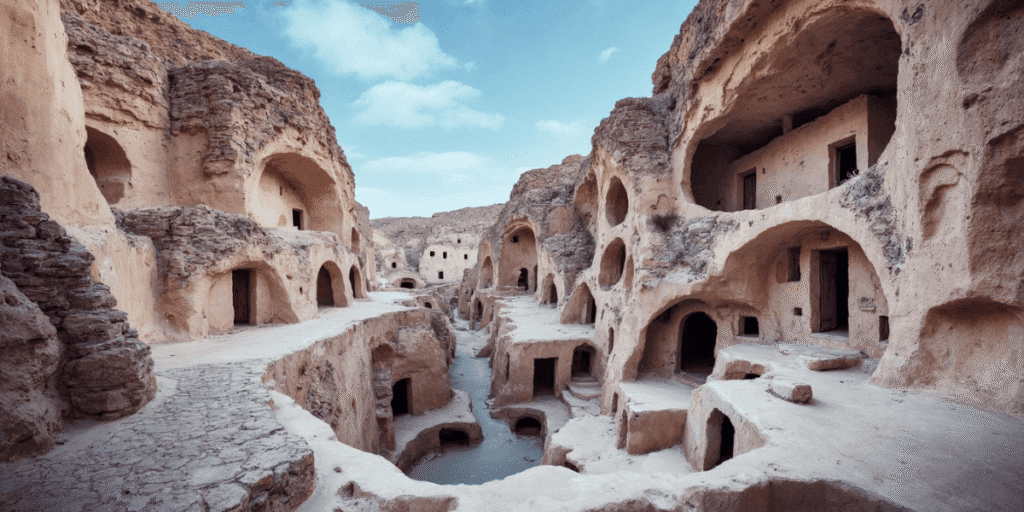
- Covered Channels: The street drains themselves were engineering marvels, constructed meticulously from burnt bricks and often covered with removable stone slabs or large bricks. This closed design prevented the accumulation of refuse and pestilence, showcasing an advanced understanding of public health.
- Maintenance Protocol: The presence of strategically placed manholes and soak pits along the street drains indicates a robust civic administration responsible for regular cleaning and maintenance a feature pointing to a society that highly prioritized cleanliness.
4. Architectural Uniformity and Standardization
The Harappans were the first great civil engineers of South Asia, demonstrating an extraordinary dedication to standardization and material quality.
- The Burnt Brick Advantage: Unlike most contemporary civilizations that relied on sun-dried mud bricks (which crumble quickly) or stone, the Harappans made extensive use of burnt (baked) bricks in their key structures, especially their homes and drains. This material provided superior durability and essential water resistance.
- The 1:2:4 Ratio: Throughout their major cities, bricks adhered to an identical, standardized ratio of dimensions (thickness : width : length = 1:2:4). This uniformity across a vast geographical area suggests a centralized authority dictating quality control and design principles – a logistical feat that is truly monumental.
5. Monuments of Utility: Public Structures
Harappan architecture prioritized functionality over grand aesthetics like temples or pyramids. Their greatest buildings were designed to serve the community.
- The Great Bath (Mohenjo-Daro): A large, deep, rectangular tank that resembles a modern-day swimming pool. It was waterproofed using natural tar (bitumen) or a gypsum coating, demonstrating sophisticated material science. Surrounded by rooms, it is widely believed to have been used for ritualistic or ceremonial bathing.
- The Granaries: The largest known structures in the Harappan cities were the massive granaries, designed for the storage of surplus food (collected as revenue or for emergencies). They featured raised platforms and internal air ducts (like sleeper walls or triangular openings) to ensure proper ventilation and protect the vital grain from moisture and pests.
- Pillared Halls: Structures like the great assembly hall at Mohenjo-Daro, featuring multiple rows of pillars, suggest the presence of a central public, administrative, or meeting space, further reinforcing the concept of organized governance.
6. Ingenious Water Management (Dholavira and Lothal)
Beyond the main cities, sites on the periphery revealed specialized genius in managing resources.
- Water Harvesting at Dholavira: Located in a dry region (Rann of Kutch, Gujarat), Dholavira boasts one of the most remarkable water management systems in antiquity. It featured a series of large, deep water reservoirs and cisterns, lined with stone and brick, designed to capture and store precious rainwater from seasonal streams a true testament to their climate resilience.
- The Dockyard of Lothal: Lothal, situated on the coast, featured a sophisticated trapezoidal brick basin. This structure is widely identified as a dockyard, which demonstrates the Harappans’ advanced knowledge of tides and maritime hydraulics, crucial for regulating water levels and facilitating trade.
Salient Features of the Town Planning of Harappan Civilization
“The foundational aspect of the Harappan Civilization’s legacy lies in its sophisticated town planning, the salient features of which provide critical insight into its governance, social structure, and technological advancement, which prioritized public health, geometric precision, and an astonishing degree of standardization.”
| Feature | Core Characteristics (Uniformity) | Deep Insights & Site-Specific Variations |
| I. City Layout & Streets | Rectangular Grid Pattern: Streets ran North-South and East-West, intersecting at precise right angles to divide the city into rectangular blocks. | Precision vs. Reality: While the grid was the ideal plan, sites like Mohenjo-Daro and Kalibangan show streets that sometimes staggered or weren’t perfectly aligned, indicating the cities were built in different phases over time, rather than a single horizontal unit. Roads were wide (up to 10m) for cart traffic. |
| II. City Division (Zoning) | Cities were typically divided into two parts: an elevated Citadel (West) and a Lower Town (East). | Variations in Structure: The Citadel in Harappa, Mohenjo-Daro, and Kalibangan was built on a high podium of mud bricks and walled. Sites like Lothal did not have this internal division; it was a single rectangular settlement. Surkotada was divided into two equal parts, built mainly of mud bricks. |
| III. Fortification & Walls | Cities were surrounded by massive fortified walls made of mud bricks, often to provide protection against floods, robbers, and raiders. | Non-Uniform Fortification: At Kalibangan, both the Citadel and the Lower City were fortified. However, sites like Kot Diji and Amri had no city-wide fortification, suggesting different regional threat levels or planning priorities. |
| IV. Residential Architecture | Houses were built around a central courtyard with rooms on all sides. They were made of baked (burnt) bricks and often had multiple stories (indicated by thick walls and staircases). | Privacy Focus: Doors and windows strictly faced the side lanes, not the main streets, to ensure privacy and reduce noise/dust. The courtyard view was typically blocked by an interior wall near the entrance. Class Distinction: Variations in house size existed from small, single-room tenements near the Granary (possibly for laborers/slaves) to larger, multi-room, double-story houses (up to 12 rooms) for wealthier families. |
| V. Sanitation & Drainage | An incredibly sophisticated closed drainage system was a hallmark. Every house had drains connected to the street gutters. The street drains were covered with manhole bricks or stone slabs at regular intervals for cleaning. | Advanced Hygiene: Drains were made water-tight using materials like mortar, lime, and gypsum. Terracotta drain pipes were used at Harappa and Mohenjo-Daro. The separation of rainwater drains from sewage pipes and the presence of toilets (often pots sunk into the floor) in nearly every house at Harappa signify a highly advanced civic administration focused on public health. |
| VI. Public Utilities (The Great Bath) | Located in the Citadel of Mohenjo-Daro, this massive brick tank (approx. $12 \times 7 \times 3 \ deep) was a unique structure. | Ritualistic Engineering: The tank was made water-tight using bitumen or gypsum mortar. It had steps at both ends and was surrounded by rooms (possibly for changing). Its design with an adjacent well and a large corbelled drain for emptying suggests its use for ritualistic or ceremonial bathing, emphasizing hygiene and purity. |
| VII. Public Utilities (Granaries) | Large, well-planned storage facilities for surplus agricultural produce, often located near the Citadel. The largest building at Mohenjo-Daro was a granary. | Air Circulation Technology: Granaries featured raised platforms and internal air ducts/sleeper walls to allow air to circulate beneath the floor, protecting the stored grains from pests and moisture a brilliant piece of engineering for long-term food security. Harappa had a series of six granaries. |
| VIII. Water Management | Harappans were experts in water sourcing, using rivers, public and private wells (over 700 wells at Mohenjo-Daro!), and large storage tanks. | Site-Specific Innovations: Dholavira is famous for its massive water harvesting and management system, utilizing large stone-lined reservoirs and step wells to collect and store monsoon runoff (covering 36% of the walled area). Lothal featured a unique trapezoidal dockyard with a sluice gate, demonstrating advanced knowledge of tides and maritime architecture for trade. |
| IX. Construction Material & Standardization | Used burnt bricks extensively for durability and water resistance, especially in drains and houses. | The Standard Brick Ratio: The most striking evidence of centralized control is the uniform brick size ratio of 1:2:4 (thickness:width:length) used across the major cities. Bricks were joined using mud mortar, with gypsum cement or natural tar for waterproofing. Stone buildings were rare. |
Town Planning of the Indus Valley Civilization (IVC) UPSC Syllabus Focus
The study of IVC town planning should cover the following core areas:
- Fundamental Principles of Layout:
- The Grid System (Rectangular layout of streets and blocks).
- The Bipartite/Tri-partite Division (Citadel, Lower Town, and Middle Town/Third Division as seen in Dholavira).
- Uniformity in Planning across major sites (Mohenjo-Daro, Harappa, Kalibangan).
- The concept of a Centralized Authority behind this planning.
- Architectural and Engineering Features:
- Standardization of Materials: The use of burnt bricks and the universal 1:2:4 ratio in brick dimensions.
- Drainage System: The sophisticated closed, subterranean network, including manholes and connections from every house (as a measure of public health).
- Water Management: The systems of private and public wells (Mohenjo-Daro) and large-scale reservoirs/dams (Dholavira).
- Specialized Structures: The design and function of the Great Bath (ritualistic/communal use) and the Granaries (food security/revenue).
- Residential and Civic Architecture:
- Privacy Rules: The placement of doors and windows opening onto side lanes, not main streets.
- House Construction: Multi-story dwellings, internal courtyards, and dedicated bathing areas/toilets within homes.
- Civic Infrastructure: Evidence of public lighting (lampposts) and waste disposal (dustbins).
- Site-Specific Variations and Exceptions:
- Lothal: The unique Dockyard (maritime trade).
- Dholavira: The Tri-partite division and advanced water harvesting system.
- Kalibangan: Fortification of both the Citadel and the Lower Town.
- Significance and Relevance:
- The socio-economic implications of the planning (hierarchy, social order, hygiene).
- Comparison with contemporary river valley civilizations (Mesopotamia, Egypt).
- Influence on present-day urbanization principles (Relevance for Mains examination).
Authors Message:-
This article, built upon a careful review of archaeological evidence, aims to take you beyond the simple “grid-pattern” concept. It highlights the incredible centralized authority, the advanced hydrological genius shown in sites like Dholavira, and the pragmatic architecture that prioritized functionality over showmanship.
My hope is that you find in this content not just facts, but a powerful idea: that good governance, a strong administrative vision, and a commitment to public welfare- epitomized by those ancient, covered drains are the true foundations of a lasting civilization.
-Sahil Sethi
Read More:-
Conclusion: A Legacy of Urban Mastery
When people think about the Indus Valley Civilizations’ development, they typically think only of a place filled with houses and streets. However, there is much more to their urban design than what would appear at first glance – it represented new ideas of how to facilitate urban living by using standards, organization, and emphasising the well-being of the populace. With plans and structures for everything from city layout to drainage systems, the Indus Valley cultures appear to have had an advanced, systematic, and possibly equal system for their entire citizenry’s health and ability to access public services.
The remaining elements from the Harappan civilization continue to be in evidence in today’s cities, since modern urban planning is based on the Harappan model. The systematic separation of business from residences through ‘zoning’, the planning of streets using ‘grid systems’, the establishment of ‘building codes’ to regulate the use of materials for construction and the invention of ‘underground waste disposal systems’ are all traceable back to engineers in the Bronze Age who used clay and baked bricks as their building materials and laid down their plans for future cities nearly 5000 years ago.
The Indus Valley Civilisation laid down the template for how cities would look and behave.
Frequently Asked Questions(Faq’s)
1. Which IVC sites show exceptions or unique features in Town Planning?
Ans. While standardization was the rule, some sites show unique adaptations:
Dholavira (Gujarat): Known for its exceptional water harvesting system, featuring multiple massive, stone-lined reservoirs and dams for rainwater storage. It is also one of the few sites with a three-part division (Citadel, Middle Town, and Lower Town).
Lothal (Gujarat): Famous for its brick-lined dockyard, confirming its role as a crucial seaport and demonstrating mastery of maritime architecture.
Chanhudaro (Sindh): It is one of the few sites that lacked a Citadel or fortification.
2. What material was primarily used for construction in the Town Planning of the Indus Valley Civilization?
The primary material was burnt (baked) bricks. Unlike many contemporary civilizations that relied on sun-dried bricks or stone, the Harappans’ extensive use of kiln-fired bricks provided superior durability, water resistance (especially for drains), and allowed for the widespread implementation of the 1:2:4 standardization ratio.
3. How does the Town Planning of the Indus Valley Civilization influence modern urbanization?
Ans- The planning has a clear influence on modern concepts such as:
Grid Layouts: Modern planned cities (like Chandigarh) follow the same rectangular street system for efficient traffic flow.
Zoning and Segregation: The division into a Citadel (administrative/public) and Lower Town (residential) mirrors modern urban zoning for functional efficiency.
Sanitation: The IVC pioneered the concept of a closed, subterranean sewage system, which is the basis for all modern municipal sanitation networks today.
4. How was the IVC city structured? Was there any social hierarchy?
The city was typically divided into two main parts:
Citadel (Upper Town): The smaller, elevated area (often built on a mud-brick platform) housing public buildings, granaries, and likely the ruling/administrative class.
Lower Town: The larger, residential area where the common citizens lived.
The variation in house size from single-room tenements to spacious, multi-room houses with private wells suggests a distinct class distinction or social hierarchy existed within the organized structure.